Showing posts with label hurricane joaquin. Show all posts

Not Ready for Prime Time (viewer discretion advised)

by Marc Goldwich

I was reviewing the headlines this morning which were chock full of mayhem.  Everything from the aftermath of catastrophic flooding which resulted in numerous drowning deaths in the South Carolina, to more school shootings, along with a smattering of auto-related fatalities vied for my attention. This combined with Halloween being just around the corner was enough to cause my mind to entertain the dark side of life. So I began thinking about the job of cleaning up after a catastrophe.

Image from commons.wikimedia.org
In case you're not aware, there is an entire industry set up for handling these kinds of events. Typically called “Biohazard Clean-up” or “Crime Scene Clean-up”, these companies are e an offshoot of emergency restoration companies. Whether the hazard you need gone consists of  toxic waste, deadly mold, body fluids or most any other kind of nasty stuff that crop up after an emergency, there are trained professionals who are only too happy to roll up their sleeves and dive right in. 

The hit Discovery TV show “Dirty Jobs” is a favorite of mine, but I doubt you will ever see Mike Rowe tackling this type of job. While certainly “dirty” enough, my guess is it would simply be too disrespectful to find any humor in this line of work, and for his show, humor plays a major role.

There are other shows which depict and deal with death, usually CSI or homicide, but I have never seen one address the clean-up aspect that invariably needs to take place after the police finish their investigation. Since you can now watch shows on just about any occupation imaginable, I would not be surprised to find a show following biohazard clean-up teams around.

So what would that entail? First let’s think about the types of situations these companies and their crews might deal with. Things like:
-          Sewage backups
From commons.wikimedia.org
-          Crime scene residue
-          Suicide
-          Homicide cleanup
-          Blood cleanup
-          Accidental death cleanup
-          MRSA and H1N1 decontamination
-          Hoarding scenes
-          Animal waste/remains
-          Chemical spills
-          Tear gas cleanup
-          Meth lab cleanup
-       Radiological hazards
    
None of these events should be taken lightly, or undertaken by anyone except certified biohazard professionals. Not that most people would want to deal with any of these problems
.
These companies need to be well versed in applicable state and federal regulations, they need to be licensed and certified (where required), they need to use appropriate transportation and/or disposal protocols, and they may need to be registered with the states’ Department of Health. These companies can also expect to be regulated by governing and advisory bodies such as OSHA (Occupational Safety and Health Administration), NIOSH (National Institute for Occupational Safety and Health), DOT (Department of Transportation), and EPA (Environmental Protection Agency).

Image courtesy of townhall.com
The dirty work of these professionals usually begins when the coroner’s office, or other governmental entity officially releases the scene to the property owner or other responsible party. Depending on the type and severity of the “event”, the clean-up teams are required to wear protective clothing, may seal off rooms to prevent or minimize the spread of airborne or physical elements of the bio-hazard scene, and follow specified methods and practices to decontaminate such scenes.

The scenes must be meticulously cleaned of all harmful material, which typically includes the removal of any porous materials (whether personal belongings like clothing and sheets, or building materials such as carpeting, wood subfloor, or drywall) – which must all be properly disposed of, and then sanitized. You can only imagine the mess that will be left, even after the mess that was the biohazard is removed.

And many people are so distraught after dealing with such a loss, that they overlook the fact that insurance may cover the expense of the clean-up efforts. Just remember this rule of thumb, if property is damaged as a result, it is probably covered by insurance (either yours, or someone else’s).
ServPro.com provided the following bio-hazard and sewage emergency tips:

After any biohazard or sewage contamination in your home or business, your primary focus should be safety:

-          Is it safe to stay in the house?
-          Exposure to biological and chemical contaminants can pose serious health consequences.
-          Flood water can contain sewage, pesticides, and other contaminants.
-          Only do activities that are safe for you to perform.
Image courtesy of aftermath.com

What to Do After a Contamination
-          Stay out of affected areas.
-          Call emergency service personnel if the situation is life-threatening.
-          Treat all bodily fluids as if they are contaminated.
-          Turn off the HVAC system if there is sewage damage.

What Not to Do After a Contamination
-          Don’t leave wet fabrics in place. Hang furs and leather goods.
-          Don’t leave books, magazines, or other colored items on wet carpet or floors.
-          Don’t use your household vacuum to remove water.
-          Don’t use television or other household appliances.
-          Don’t turn on ceiling fixtures if ceiling is wet, and keep out of rooms where ceilings are sagging.

Let’s all hope we never need these tips, but as we can plainly see from watching the news, the fact is, biohazard clean-up is a grim reality for many families. As with anything else, the more you know in advance of an emergency, the better equipped you will be in handling that situation.

In this article I discussed the subject of biohazard clean-up, and the professionals that are trained to perform what just might be the dirtiest job of all. I mentioned some of the types of events this might involve, and included tips for dealing with such an event.

Mark Goldwich is president of Gold Star Adjusters, a group of public insurance adjusters dedicated to helping citizens get the maximum settlement for any insurance claim.   

Who'll Stop the Rain?

by Mark Goldwich

Hurricane Joaquin image courtesy of Flickr.com
The latest news has the fairly sizable hurricane Joaquin threatening the East Coast of the United still recovering from 2012’s “Superstorm” Sandy. You may recall New Jersey experienced especially devastating flooding when Sandy drenched that region.
States, even though the most current predictions are it will never make U.S. landfall.  However, a storm as big as this doesn't have to hit to produce coastal flooding by the time Joaquin exits the area. In fact, the Carolinas are already experiencing flooding completely unrelated to this hurricane, so any additional rains as a result of Joaquin will make things dramatically worse. I also noted that emergency preparations are already underway in New Jersey, which is

I will first start with this – if you don’t already have flood insurance, you should seriously consider getting it as soon as possible. It may be too late for you to be covered in the event Hurricane Joaquin does strike, but there will always be another event that causes flooding, which very few of us are immune. I have been saying for years that “we are all in a flood zone, it just may not have happened yet.” Even if the place you live is not recognized as a flood zone by FEMA or a mortgage company that doesn't mean that flooding can't occur. If you are in a “low-risk” flood zone (as determined by FEMA), your mortgage company may not require you purchase flood insurance, yet your property may still be at risk. Countless people make that mistake each and every year, with dire financial consequences. And that may never change, at least not for everyone, but if you are reading this, I hope you will act now, and not become a statistic. Another of my flood-related sayings is, “if you place too much trust in FEMA flood maps today, you may be waiting in FEMA assistance lines tomorrow!”

Here are some interesting flood facts from www.FloodSmart.gov:
  • In the past 5 years, all 50 states have experienced floods or flash floods.
  • Homeowners' insurance does not cover flood damage.
  • Just a few inches of water from a flood can cause tens of thousands of dollars in damage.
  • A car can easily be carried away by just two feet of rushing water.
  • New land development can increase flood risk, especially if the construction changes natural runoff paths.
  • Federal disaster assistance is usually a loan that must be paid back with interest. For a $50,000 loan at 4% interest, your monthly payment would be around $240 a month ($2,880 a year) for 30 years. Compare that to a $100,000 flood insurance premium, which is about $400 a year ($33 a month).
  • A Preferred Risk Policy provides both building and contents coverage for properties in moderate- to low-risk areas for one low-price.
  • You are eligible to purchase flood insurance as long as your community participates in the National Flood Insurance Program. Check the Community Status Book to see if your community is already an NFIP partner.
  • In most cases, it takes 30 days after purchase for a policy to take effect, so it's important to buy insurance before the storm approaches and the floodwaters start to rise.
  • In a high-risk area, your home is more likely to be damaged by flood than by fire.
  • Even though flood insurance isn't federally required, anyone can be financially vulnerable to floods. In fact, people outside of mapped high-risk flood areas file over 20-percent of all National Flood Insurance Program flood insurance claims and receive one-third of Federal Disaster Assistance for flooding.
  • From 2005 to 2014, total flood insurance claims averaged more than $3.5 billion per year.
  • Since 1978, The NFIP has paid nearly $50 billion for flood insurance claims and related costs.
  • There are currently more than 5.3 million flood policies in force across more than 22,000 communities in the U.S.
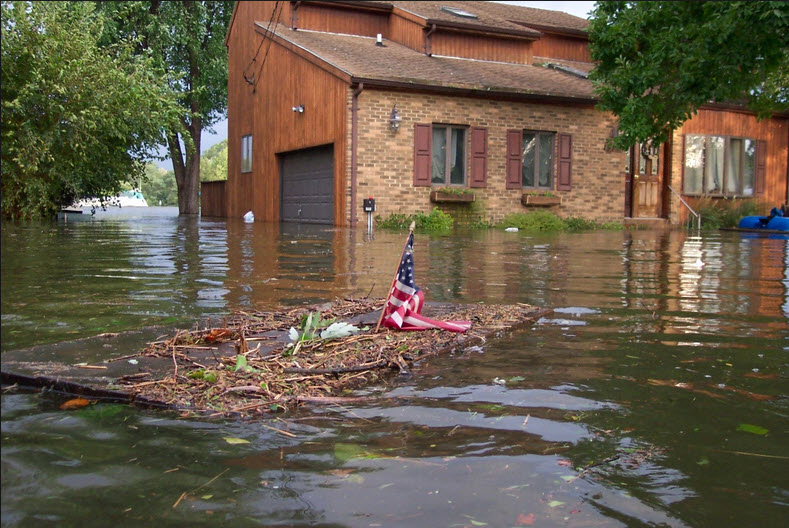
Image courtesy of commons.wikimedia.org
These are sobering statistics, which should make all non-insured homeowners pause to consider. It would be great if more people did know more about how flood insurance works, and who it can protect. Too many individuals and families are impacted each year simply because they got bad information about flood insurance, didn’t understand the information they were given, or didn’t have the resources to obtain the correct information. My goal would be to reach at least one person, and make a difference.

Along these lines, there was another section at FloodSmart which detailed common misconceptions about flood insurance. It was there I learned that floods are the #1 natural disaster in the country, and that many people (wrongfully) believe they are somehow not eligible for flood insurance, either because of where they live, or their mortgage status. I can’t tell you how many people have told me after the fact that they didn’t think they needed flood insurance because “the mortgage company said it wasn’t necessary.” The mortgage company probably said it wasn’t “required”, or maybe that is what they meant to say, but either way, the message was lost in translation.

The fact is, according to NFIP (National Flood Insurance Program):
  • You CAN get flood insurance nationwide.
  • You CAN get flood insurance if you live in a floodplain or high-flood-risk area.
  • You CAN get flood insurance if you live outside a floodplain, or a low-to-moderate flood-risk area, and at lower cost.
  • You CAN get flood insurance if your property has been flooded before.
  • You CAN get flood insurance from insurance agents in your area.
  • You CAN buy flood insurance even if your mortgage broker doesn't require it.
Fill out the form below to get your Free Copy.

Were you already aware of all this? If so, wonderful – you are a flood maven! If not, it might be time to do a little more research. People with accurate information about flood risks and protection options can make better decisions and plan for disasters. Sometimes the key is knowing who to ask, or where to look before the storm clouds gather and you begin to wonder, "Who'll stop the rain?"


In this article I used current weather conditions to again remind people of the need to prepare for potential disasters like flooding, and the cost of failing to do so. I also provided information from a valuable resource on the subject of flooding, www.FloodSmart.gov, and presented statistics and misconceptions to help people gauge their own levels of understanding on this topic. I hope you scored well!

Mark Goldwich is president of Gold Star Adjusters, a group of public insurance adjusters dedicated to helping citizens get the maximum settlement for any insurance claim.