Showing posts with label storm preparedness. Show all posts

Who'll Stop the Rain?

by Mark Goldwich

Hurricane Joaquin image courtesy of Flickr.com
The latest news has the fairly sizable hurricane Joaquin threatening the East Coast of the United still recovering from 2012’s “Superstorm” Sandy. You may recall New Jersey experienced especially devastating flooding when Sandy drenched that region.
States, even though the most current predictions are it will never make U.S. landfall.  However, a storm as big as this doesn't have to hit to produce coastal flooding by the time Joaquin exits the area. In fact, the Carolinas are already experiencing flooding completely unrelated to this hurricane, so any additional rains as a result of Joaquin will make things dramatically worse. I also noted that emergency preparations are already underway in New Jersey, which is

I will first start with this – if you don’t already have flood insurance, you should seriously consider getting it as soon as possible. It may be too late for you to be covered in the event Hurricane Joaquin does strike, but there will always be another event that causes flooding, which very few of us are immune. I have been saying for years that “we are all in a flood zone, it just may not have happened yet.” Even if the place you live is not recognized as a flood zone by FEMA or a mortgage company that doesn't mean that flooding can't occur. If you are in a “low-risk” flood zone (as determined by FEMA), your mortgage company may not require you purchase flood insurance, yet your property may still be at risk. Countless people make that mistake each and every year, with dire financial consequences. And that may never change, at least not for everyone, but if you are reading this, I hope you will act now, and not become a statistic. Another of my flood-related sayings is, “if you place too much trust in FEMA flood maps today, you may be waiting in FEMA assistance lines tomorrow!”

Here are some interesting flood facts from www.FloodSmart.gov:
  • In the past 5 years, all 50 states have experienced floods or flash floods.
  • Homeowners' insurance does not cover flood damage.
  • Just a few inches of water from a flood can cause tens of thousands of dollars in damage.
  • A car can easily be carried away by just two feet of rushing water.
  • New land development can increase flood risk, especially if the construction changes natural runoff paths.
  • Federal disaster assistance is usually a loan that must be paid back with interest. For a $50,000 loan at 4% interest, your monthly payment would be around $240 a month ($2,880 a year) for 30 years. Compare that to a $100,000 flood insurance premium, which is about $400 a year ($33 a month).
  • A Preferred Risk Policy provides both building and contents coverage for properties in moderate- to low-risk areas for one low-price.
  • You are eligible to purchase flood insurance as long as your community participates in the National Flood Insurance Program. Check the Community Status Book to see if your community is already an NFIP partner.
  • In most cases, it takes 30 days after purchase for a policy to take effect, so it's important to buy insurance before the storm approaches and the floodwaters start to rise.
  • In a high-risk area, your home is more likely to be damaged by flood than by fire.
  • Even though flood insurance isn't federally required, anyone can be financially vulnerable to floods. In fact, people outside of mapped high-risk flood areas file over 20-percent of all National Flood Insurance Program flood insurance claims and receive one-third of Federal Disaster Assistance for flooding.
  • From 2005 to 2014, total flood insurance claims averaged more than $3.5 billion per year.
  • Since 1978, The NFIP has paid nearly $50 billion for flood insurance claims and related costs.
  • There are currently more than 5.3 million flood policies in force across more than 22,000 communities in the U.S.
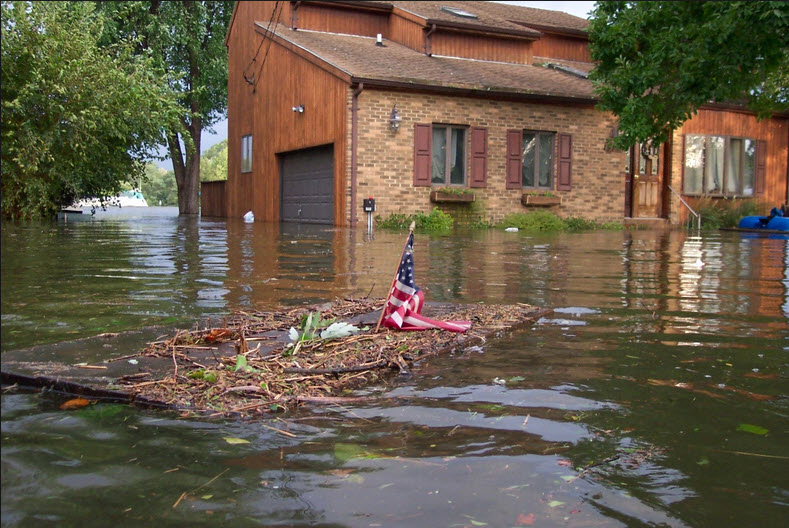
Image courtesy of commons.wikimedia.org
These are sobering statistics, which should make all non-insured homeowners pause to consider. It would be great if more people did know more about how flood insurance works, and who it can protect. Too many individuals and families are impacted each year simply because they got bad information about flood insurance, didn’t understand the information they were given, or didn’t have the resources to obtain the correct information. My goal would be to reach at least one person, and make a difference.

Along these lines, there was another section at FloodSmart which detailed common misconceptions about flood insurance. It was there I learned that floods are the #1 natural disaster in the country, and that many people (wrongfully) believe they are somehow not eligible for flood insurance, either because of where they live, or their mortgage status. I can’t tell you how many people have told me after the fact that they didn’t think they needed flood insurance because “the mortgage company said it wasn’t necessary.” The mortgage company probably said it wasn’t “required”, or maybe that is what they meant to say, but either way, the message was lost in translation.

The fact is, according to NFIP (National Flood Insurance Program):
  • You CAN get flood insurance nationwide.
  • You CAN get flood insurance if you live in a floodplain or high-flood-risk area.
  • You CAN get flood insurance if you live outside a floodplain, or a low-to-moderate flood-risk area, and at lower cost.
  • You CAN get flood insurance if your property has been flooded before.
  • You CAN get flood insurance from insurance agents in your area.
  • You CAN buy flood insurance even if your mortgage broker doesn't require it.
Fill out the form below to get your Free Copy.

Were you already aware of all this? If so, wonderful – you are a flood maven! If not, it might be time to do a little more research. People with accurate information about flood risks and protection options can make better decisions and plan for disasters. Sometimes the key is knowing who to ask, or where to look before the storm clouds gather and you begin to wonder, "Who'll stop the rain?"


In this article I used current weather conditions to again remind people of the need to prepare for potential disasters like flooding, and the cost of failing to do so. I also provided information from a valuable resource on the subject of flooding, www.FloodSmart.gov, and presented statistics and misconceptions to help people gauge their own levels of understanding on this topic. I hope you scored well!

Mark Goldwich is president of Gold Star Adjusters, a group of public insurance adjusters dedicated to helping citizens get the maximum settlement for any insurance claim.   

Weathering the Storm

Hurricane Helene 18 sept 2006
Hurricane Helene 18 sept 2006 (Photo credit: Wikipedia)


By Mark Goldwich

“Everyone talks about the weather, but no one does anything about it.”  At least that’s the way that Mark Twain saw it.  Here in Florida, as well as the Gulf Coast of the US at this time of year we do more than talk about the weather.  We fret over it, since hurricane season is once more upon us.  Beginning on June 1st and ending on November 30th, this six month time span is also known as the time when storm preparation can literally mean the difference between life and death.  Anywhere in between there can be expected a number of “Named Storms” including those containing hurricane force winds of 74 mph or greater. While the current hurricane season has been quiet thus far, NOAA is predicting a dozen named storms with half of these growing to hurricane strength.  It’s this sense of false security that lulls many people into being complacent when it comes to preparing for the worst.  As we all remember from a late season hurricane that ravaged the Northeast in October 2012 named Sandy, when it comes to hurricane preparation, talk is cheap. 

Projected path of Tropical Storm Norman (2006)...
Projected path of Tropical Storm Norman (2006). From NOAA (Photo credit: Wikipedia)
Aside from high winds, hurricanes also deliver a tremendous amount of water in the form of rain and from coastal areas storm surge.  Dollar-for-dollar and ounce-for-ounce, more property is damaged and more lives are lost due to water than wind when it comes to major storms and hurricanes.  Storm surges can reach depths of 20 feet or more, flooding entire towns and even carrying away or battering down homes and businesses.  Hurricanes can also cause more than six inches of precipitation, which have been known to produce widespread flooding.   This, combined with winds high enough to bring down trees and power lines, means that if caught in a hurricane, you and yours could be left without power and clean water for days or even weeks.  So it is vital you create and establish an emergency plan that can help you and your family weather the storm.  And the time to create this plan is not when a hurricane is imminent.

Below is a list of items that every homeowner needs to consider this hurricane season:

Hurricane Preparedness Program @ Your Library
Hurricane Preparedness Program @ Your Library (Photo credit: hcplebranch)
Protection:  The last thing you want to do is be caught in the cattle call at the local big box store fighting for the last few pieces of plywood needed to protect your windows from wind damage.  Today, there are a number of ways to protect your doors and windows in the case of a major windstorm.  These include hurricane shutters, Storm Stoppers http://www.storm-stoppers.com/, Hurricane Fabric http://hurricanefabric.com/, accordion shutters, sliding and roll down screens and more. http://stormsmart.com/hurricane-protection/products/  Once installed, these systems are ready to deploy in the event of any major wind storm.  Many times insurance companies will even give homeowners that employ these devices a reduction on the windstorm protection portion of their policies.  (Check with your insurance agent to find out more.)  You should also invest in a number of large nylon tarps and ropes so that you can cover any roof damage that can be caused by wind and weather.  Unplug all non-essential appliances and turn your refrigerator to its coldest setting.  (Stock up on ice as well, since this can keep your food fresh for up to 72 hours provided you don’t open the fridge frequently or for long periods of time.)

A hurricane evacuation route shield in New Orl...
A hurricane evacuation route shield in New Orleans, Louisiana, after Hurricane Katrina (Photo credit: Wikipedia)
Evacuation:  In the event that discretion becomes the better part of valor and you decide to evacuate your neighborhood due to a major storm, make sure you not only know the best evacuation route, but also pack enough provisions to enable you to get to where you are going.  Many times, highways turn into parking lots as the populace all try to get out of Dodge at once.  When this happens, traffic snarls are inevitable and many times gasoline will be unavailable at any price.  Bringing extra fuel along with food, water and even a tent is a good idea if you decide to evacuate.  Also, make sure you have a battery powered radio with you so you can receive updates on the continuing crisis. 


Communication:  Once the power goes out so will most means of communications, including the Internet and cellphones.  Unless you have a backup generator, this also means that your television will go dark as well.  Make sure you have a battery powered radio on hand with a substantial supply of batteries.

English: Orange, TX 9/28/05 -- Ice, food, and ...
English: Orange, TX 9/28/05 -- Ice, food, and water are given to Rita victims at a distribution center coordinated by FEMA. Photo by:Liz Roll (Photo credit: Wikipedia)
Food and Water: Whether you choose to hunker down in your home or evacuate, you will need to eat and drink.  So make sure you have a substantial supply of potable water (1 gallon per person per day) and non-perishable food to last you several days (if you flee) or even several weeks (if you stay).  Just as with plywood, supermarket shelves will be quickly stripped bare in the event of a predicted hurricane.  So it is vital that you stock up on drinking water, canned goods, cereal, crackers, coffee, powdered milk, dehydrated soup and other foodstuffs well in advance of a panic.  You will also need something with which to cook on, such as a gas grill or camp stove.  If you remain home, you should also fill your bathtub and sinks with water before the hurricane hits, since clean water for cleaning and bathing could be hard to come by once the storm hits. 

Emergency Medicine: Having a box of bandaids isn’t going to cut it in the event of an emergency.  Every family should invest in a prepackaged first aid kit that can handle everything from cuts and scrapes to broken bones and contusions.  Also, make sure that you have an adequate supply of any prescription medications you currently take.  It could be quite some time before you can go to the pharmacy. 

Burning brightly ~ hope for Haiti
Burning brightly ~ hope for Haiti (Photo credit: EraPhernalia Vintage . . . (playin' hook-y ;o))
Shelter and Power:  Once the storm has passed, you may find that your home is no longer habitable.  If that’s the case, having a tent or tents big enough for the entire family could prove to be a godsend.  Since power is one of the first things to go out and the last things to be replenished after a major storm, many people rely on auxiliary generators to provide power to their homes.  If you have purchased one of these, you need to ensure it is in proper working order long before storm warnings are issued.  You also need to make certain you have an ample supply of fuel and that you have extension cords long enough to enable you to position the unit far from your home.  (Generators have been involved in a number of fatalities from carbon monoxide poisoning.)

Sun Insurance Policy Receipt
Sun Insurance Policy Receipt (Photo credit: Laineys Repertoire)
Insurance: Once again, proving that the last shall be first and the first shall be last, it is vital to your ability to recover from a major weather event that your insurance policies are current, comprehensive, and at-hand before the lights go out and the wind and rain starts to assail your property. 


In short, if you live in any part of the country that is vulnerable to storms or flooding, preparing for the worst can be one of the best things you can do to keep you and your family safe and help you weather the storm.

Mark Goldwich is president of Gold Star Adjusters, a group of public insurance adjusters dedicated to helping citizens get the maximum settlement for any insurance claim.